

Heat Transfer Film Cutter for Garment Printing
If you're running a garment decoration operation — DTF printing, heat transfer vinyl, sublimation film — you already know that buying film in rolls is the only way to control material costs at volume. Sheets are convenient but expensive. Rolls are economical but require an extra step before they're usable: cutting them down to size. This post is for production operators who do that cutting every day and are looking for a faster, more consistent way to handle it.
Why Garment Decorators Buy Film in Rolls
Heat transfer film — whether it's DTF PET film, HTV, sublimation transfer paper, or specialty garment film — is sold in both sheet and roll formats. Roll pricing is significantly lower per square foot, and rolls let you work to any sheet length rather than being locked into a standard size.
For a shop running dozens or hundreds of transfers per day, buying rolls isn't just a cost decision — it's a workflow decision. You control the sheet dimensions to match your press platens, your gang sheet layouts, or your specific garment sizes. A 13" × 19" sheet from a distributor doesn't always match the output you actually need.
The tradeoff is that someone has to cut those rolls. In most shops, that means a guillotine trimmer, a utility knife and straightedge, or — most commonly — a person standing at a table pulling and cutting by hand.
The Hidden Cost of Manual Film Cutting
Hand-cutting film rolls looks simple but the time adds up. That's labor cost off the bottom line. Not to mention time lost to inconsistent lengths, skewed cuts, or film that shifts mid-pull and has to be recut.
Film is also an unforgiving material to cut manually. DTF PET film and heat transfer vinyl are slippery, tend to static-cling, and don't lay flat the way paper does. Getting a square, repeatable cut requires more care and more time during a busy production run.
Inconsistent sheet lengths create downstream problems too: film that's slightly too short for a gang sheet layout wastes print capacity; film that's too long bunches in the press or gets trimmed again after the fact.
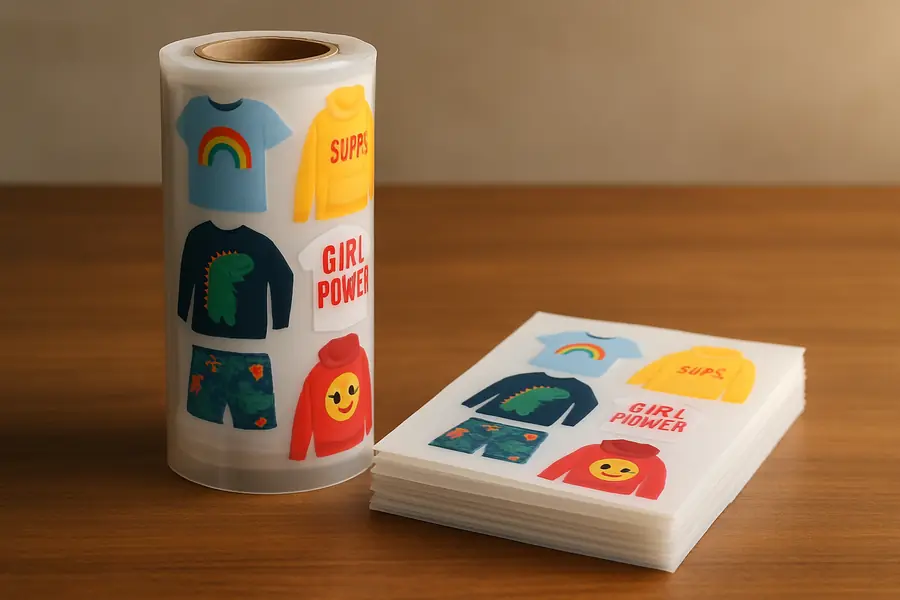
Automating Film Sheeting for Garment Production
The Krexil roll cutter is a motorized sheeting machine that feeds film from a roll and cuts it to a programmed length. You set the cut length once, load a roll, and the machine runs — producing consistent sheets at a rate no manual process can match.
For standard heat transfer film and DTF PET film, the cutter handles the material cleanly without stretching, skewing, or leaving static-distorted edges. The cut length is repeatable to within a tight tolerance, so every sheet in a run comes out the same.
For shops running printed DTF rolls — where the designs are already printed on the roll and need to be cut at specific registration points rather than a fixed interval — the optional Mark Sensor accessory detects printed marks on the film and triggers the cut automatically. This is the right setup for any operation where gang sheets are printed to roll and then sheeted for pressing.
Key production benefits:
- Consistent sheet length across an entire roll run
- No operator standing at the table — load and walk away
- Handles DTF PET film, HTV, sublimation transfer paper, and other garment films
- Mark Sensor option for printed-roll sheeting at registration marks
If your operation buys heat transfer film in rolls and cuts it to sheets before pressing, the time savings and material consistency pay for the machine quickly — especially at production volumes of 30 sheets or more per day.
Ready to eliminate manual film cutting from your production workflow? Visit the Krexil Film Roll Cutting Machine page for specifications and ordering information.